Monday, October 26, 2009

Freshwater Spirulina

Freshwater Spirulina (fusiformis)

This post is extracted from the Yahoo Groups: Spirulina-Group and is in the format of question and answers.

QUESTION:

I am looking for a fresh water Spirulina variant (Spirulina fusiformis). My aquaponics setup is strictly fresh water. I grow freshwater algae. I want to start growing Spirulina: Spirulina is the most balanced algae. I am trying to create a balanced algae diet for freshwater prawns, freshwater mussels, and fresh water tilappia. If there is not a freshwater Spirulina variant, then I need to find out how to incorporate the Spirulina into my system. I use the animal affluent to feed the algae. The algae filters, and cleans the affluent water. The cleaned water is then recycled back into the tanks. The animals eat the algae infused water. Right now, the alga is not a complete balanced algae feed. I would like to combine several algae and create a balanced live algae food.

I have seen on the internet that marine Spirulina contains much more nutrients than the fresh water variant. Is this true?

ANSWER:

To date there is no any variant of Spirulina which grows on fresh water or on neutral pH, all strains need the high pH and I think the high pH is not suitable for your aquaponics setup. You should grow the Spirulina in different tank (with correct chemistry, lighting, etc. for Spirulina growth) and then after harvesting, you can add it as a feed in the form of powder/ granules. Moreover, if you are looking for a fresh water nutritious algae then you can try the chlorella or nannochloropsis etc. green algae.
As well, there is not any significant variation in the marine and fresh water Spirulina strain.

"True" Spirulina needs such alkaline conditions other such aquatic life is inhibited. That is why it can be mass cultivated with minimal contamination.
Your best approach may be a polyculture of the afore mentioned chlorella, nannochloropis. Try adding also some nannochloris and diatoms, as many varieties as you can find. Without even trying you are likely going to get some other "wild" algae. Just watch out for potentially toxic algae which can easily foul your system.

Please see this article for further information about the use of Spirulina in aquariums/aquaculture:
Spirulina Algae; The Aquatic/Aquaculture Health Benefits for Tropical, Marine and Goldfish

Wednesday, June 03, 2009

Growing Spirulina Algae

Growing Spirulina can be really easy.
Start with the purchase of a live culture, then place it in sterilized creek, well, etc. water (freshwater) that had been altered by adding Sea salts, and PH brought up to a minimum of 8.4-8.8.
It is then placed it out doors. Night time temperature should not fall below
45F.

You have to adapt the culture first to salty sea water first if it was not used to it normally in the beginning medium. Adaptation needs some patience as well. You have to mix your culture with sea water slowly and every day with small amounts so that it can adapt easier. Sudden medium changes can result in osmotic shocks and the entire culture is dead. Divide the culture in different cups and make your trials separated and work on the method that works.

Spirulina cannot grow ONLY in seawater. It would also need soda ash, micro-nutrients, & bicarbonate to grow as well. The optimum ph is around 10 and the optimum temp is around 28-29 C (82-84 F). It is important that the equipment and the cups are free of other algae. The water should also be free of algae. You may boil the water before using as a practical way.

For more about Spirulina Algae’s health benefits for use in feeding both freshwater AND saltwater fish & invertebrates please see this excellent article:
Spirulina Algae; The aquatic health benefits for Tropical, Marine and Goldfish

Saturday, June 17, 2006

Spirulina Algae as a diet for fish.

WHAT IS SPIRULINA?

Spirulina is a planktonic blue-green algae found in warm water alkaline volcanic lakes rich in raw protein and seven major vitamins: A1, B1, B2, B6, B12, C and E. It naturally contains beta-carotene, color enhancing pigments, and whole range of minerals. In addition, Spirulina has a 62% amino acid content and contains all essential fatty acids and eight amino acids required for complete nutrition. Spirulina is different from other algae and is similar to bacteria in many ways, occupying a niche between plants and bacteria. Spirulina is similar to cyanobacteria in structure (spiral shape, unlike true plant plankton), which can be toxic. Spirulina Blue- Green algae are recognized by the body (fish in particular) as a bacterium, causing an increase in antibodies, which in turn increases disease resistance. Spirulina is not Chlorella (the blue-green algae harvested from Klamath Lake, Oregon). Chlorella is a green micro-algae and does not have the same anti-viral, anti-cancer and immune stimulating properties of Spirulina. The Chlorella cell wall is made of indigestible cellulose, just like green grass, while the cell wall of Spirulina is made of complexed proteins and sugars.

Spirulina has a soft cell wall made of complex sugars and protein, and is different from most other algae in that it is more easily digested. Spirulina is also high in usable or digestible amino acids (the building blocks of proteins); proteins from cereal and soy are not as digestible by fish as the amino acids found in spirulina. An analogy used at a pet food seminar I attended was this: You can achieve the protein analysis on many pet foods with a used pair of leather shoes, but leather shoes contain little usable proteins.


Here is the general analysis of pure Spirulina Algae:

Protein: 55%- 70%
Carbohydrates: 15% - 25% (an excellent low ratio for fish)
Fats (lipids): 6% - 8%
Minerals: 6 -13%
Fiber: 8% - 10%

Natural Pigment Enhancers:

Phycocyanin (Blue): 14%
Chlorophyll (Green): 1%
Carotenoids (Orange/ Red): 47%

Important Trace Minerals (many of these are essential for proper electrolyte balance and osmotic function):

Calcium, Iron, Phosphorus, Iodine, Magnesium, Zinc, Selenium, Copper, Manganese, Chromium, Molybdenum, Sodium, Chloride, Potassium, Germanium, Boron.

FOR MY FULL ARTICLE ABOUT SPIRULINA ALGAE:

Spirulina Algae; The aquatic health benefits for Tropical, Marine and Goldfish.


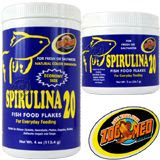
WHAT CAN SPIRULINA 20 DO FOR YOUR FISH?
Spirulina 20 flakes contain a full 20% Spirulina and provide a complete high protein diet for freshwater, saltwater fish, goldfish, crustaceans, and invertebrates. Spirulina 20 is a particularly ideal food for the vegetative needs of African Cichlids, Livebearers, in addition to Saltwater Tangs and Angels.
Research has shown that fresh and saltwater fish exhibit superior growth, maturity, energetic behavior, and more elegant coloring when fed Spirulina. It is also well documented that Sprulina improves egg production and hatching rates, stimulates the reproductive processes, increases survival rates of younger fish, and arouses the appetite of fish.


INGREDIENTS FOR SPIRULINA 20 FLAKE:
Spirulina, ground whole wheat, whole fish meal, defatted soy meal, wheat flour, torula dried yeast, vital wheat gluten, fish oil, biophos, soy oil, lecithin, natural colors.

GUARANTEED ANALYSIS:
Min. Crude Protein- 40%
Min. Crude Fat- 6%
Max Crude Fiber- 2%
Max Moisture- 8%

NET WEIGHT 4 OZ.


Spirulina 20 Fish Flake

OTHER INTERESTING LINKS

AQUARIUM MEDICATIONS, TREAMENTS AND HOW THEY WORK A GREAT resource for information about aquarium (and pond) medications, whether they are gram negative or positive and their effectiveness.

Goldfish and Tropical fish Food Basic information about Sanyu Goldfish and Tropical fish food.


ABOUT ME
An autobiography about me; Carl Strohmeyer, my interests, family, business, and trials

Aquarium Disease Prevention A blog about the basics of aquatic disease prevention